
Workshop
Where dealers quietly lose money
Not in one dramatic loss. In an hour here, a filter there, and a job that was quoted at a number nobody checked against what it actually took.
Replaces: a paper job card, a whiteboard of who is on what, and hours remembered at the end of the week.
1:04 to watch
How it goes today
- Jobs are estimated on the spot and never compared with what they cost.
- Labour hours are written down at the end of the week, if at all.
- Parts get fitted and never make it onto a bill.
What Stalmio does instead
- Check in with photos and the customer's signature, Approved up to an amount before anyone starts.
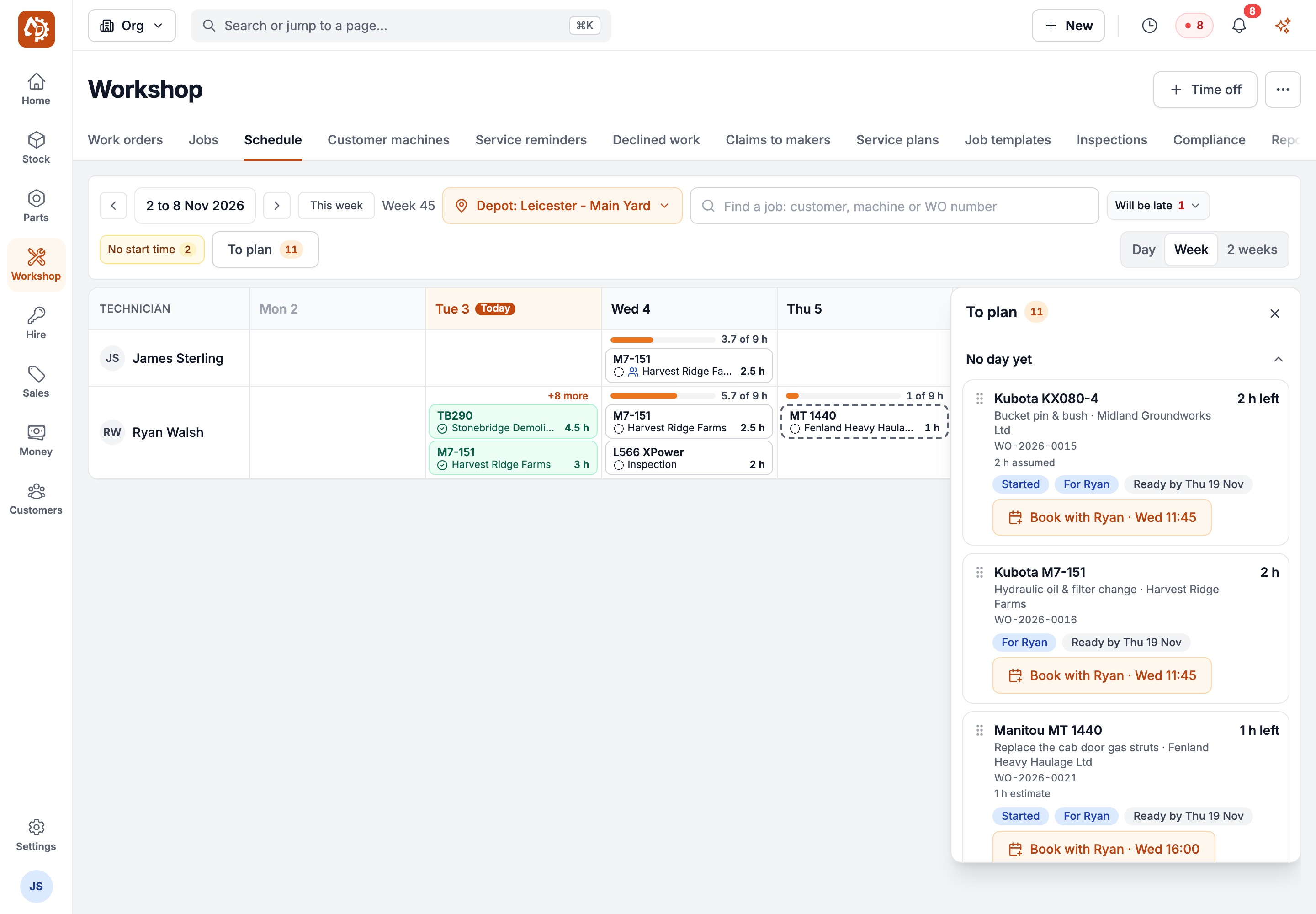
- Jobs at standard time from your own templates per model, on a planner you drag and drop.
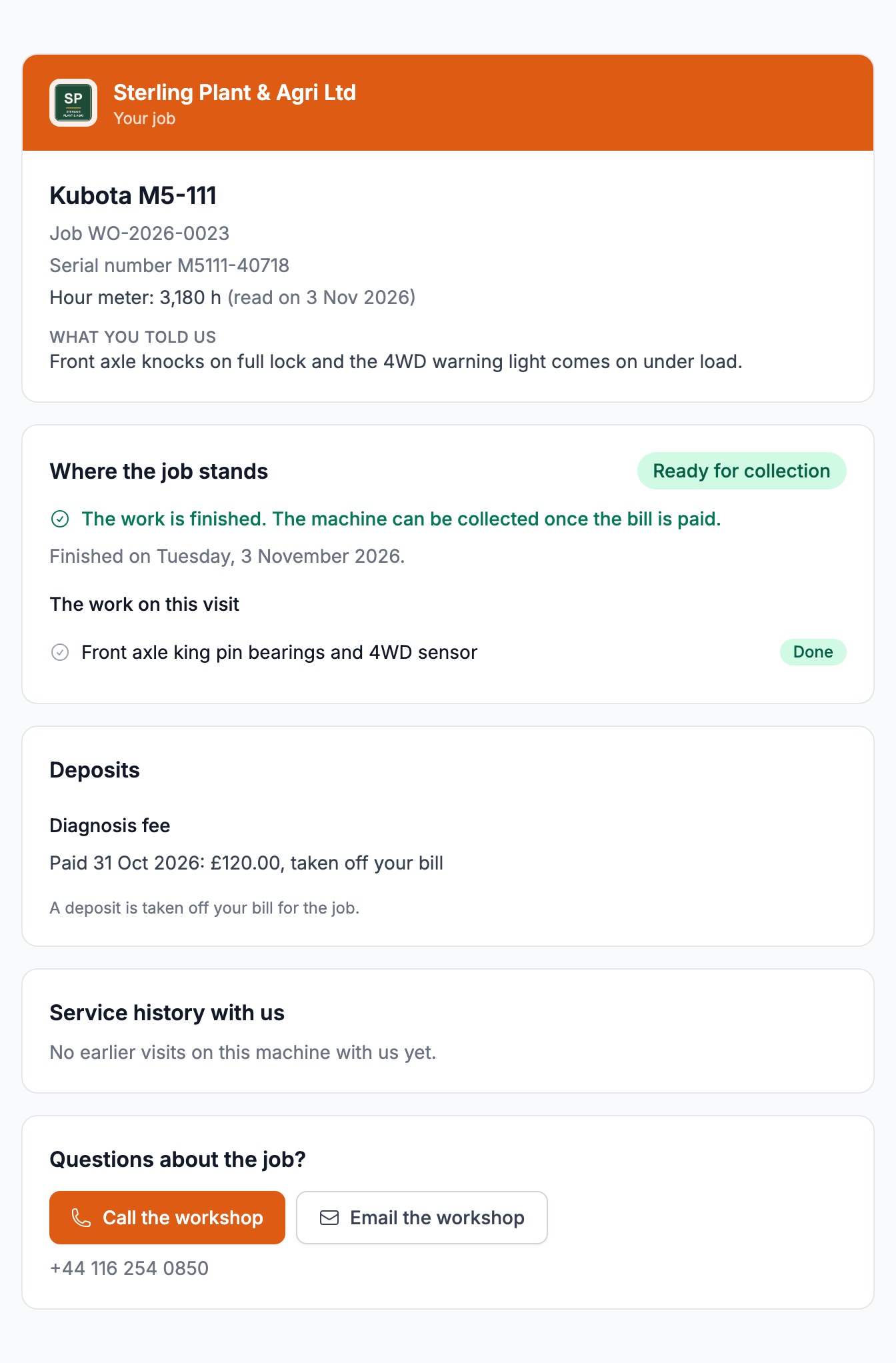
- Customers follow the job on a status page and approve Extra work line by line online.
What you get today
- Check in at the counter: condition photos, items left with the machine, the customer signs on screen.
- Approval your way: written, written up to an amount, signed job card, or verbal.
- Quotes as an estimate, a fixed price or a maximum price. Extra work waits for approval.
- Job templates per maker and model, with standard time, parts and checklist.
- "Your last 5 jobs like this averaged 3.2 h", from your own history.
- Complaint, cause and correction on every job, with before and after photos.
- Planner: To plan, drag and drop with Undo, bays, time off, extra shifts and Will be late.
- Shop rate, plus rates by type of work, machine size and customer; evening, weekend and bank holiday rates; a minimum charge.
- Diagnosis fee, taken off the repair when the customer goes ahead.
- Parts held for each job, with Parts not in and a check before Start.
- Customer messages when a job starts, goes on hold or is ready.
- Collection: hold the machine until paid, or release it with a reason.
What is said in the video
The narration, word for word, in case you are somewhere you cannot turn the sound on.
- 0:00The workshop is where dealers quietly lose money.
- 0:04Jobs estimated on the fly, hours never written down, parts fitted and never billed.
- 0:10At Sterling every job is a work order, with the cost of the month on top.
- 0:17This Bobcat is being prepped for sale. Estimate eight hundred and fifty.
- 0:23Actual so far, five hundred and fifteen. Thirty nine percent under, while the job is still open.
- 0:30Six hours of labour at fifty five, and a set of bucket teeth. Line by line.
- 0:38And this one is warranty work, so Stalmio knows who pays.
- 0:43In cover, a hundred and sixty three days left, and the claim already logged.
- 0:48Warranty work never goes on the customer bill by mistake.
- 0:53When the job is done, the money is already on it. Nothing fitted, nothing forgotten.
Questions dealers ask
- Can I tell whether a job is running over while it is still open?
- Yes. The estimate and the actual sit together on the work order from the first hour booked, so a job going wrong is visible while you can still do something about it rather than at the point of billing.
- How are warranty jobs kept off the customer's bill?
- Each job, charge and trip has its own Who pays: The customer, Warranty or Goodwill. Warranty lines go on a claim to the maker, and the customer's bill shows only what the customer pays.
- Where do the parts on a job come from?
- The same catalogue the counter sells from. Fitting a part takes it off the shelf and puts it on the job, so stock and billing stay honest without a second entry.
See it on your own stock
A demo is a conversation, not a slideshow. Bring your machines, your hire fleet and the part of the week that annoys you most.
Book a Demo